// PERSONAL
AN ANGULAR PORT OF AN EXISTING REACT APP, BUILT TO CLOSE A REAL SKILL GAP
A deliberate Angular rebuild of three screens from Paste Up — my Next.js/Supabase gig-listings site — reusing its real data through a small REST API added for this purpose. Built to get real, hands-on Angular experience (standalone components, Signals, Reactive Forms) for a stack that turns up in a smaller but real cluster of job postings I couldn't yet honestly apply for.
- CLIENT
- Personal project
- ROLE
- Front-end development, Back-end development
- DURATION
- One sitting, ~2 hours
- YEAR
- 2026
ConsoleView exists for the same reason DeskLog does: a gap, not a feature idea. Angular keeps showing up in a smaller but real slice of the NZ roles I was scanning, and I hadn't built anything real in it. Rather than start a throwaway to-do app, I picked three screens — event list, event detail, filter form — from Paste Up, a Next.js/Supabase gig-listings site I'd already built, and rebuilt just the frontend in Angular against the same real data. The README says so explicitly: this is a deliberate port to demonstrate Angular fluency, not confusion about which framework I reach for day to day.
The backend I thought I could reuse didn't actually exist
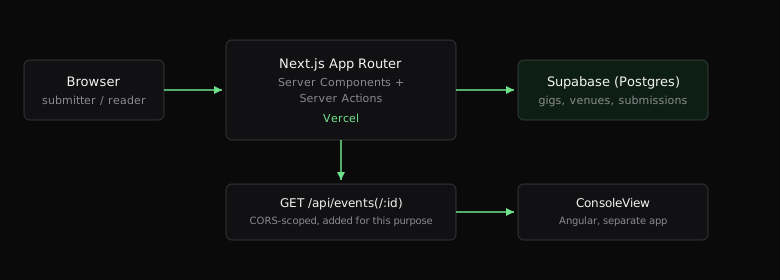
The plan was "point Angular at Paste Up's existing API." Paste Up didn't have one. It's
Next.js App Router calling Supabase directly from Server Components and Server Actions —
no Express layer, no REST routes, nothing an external client could call. Before ConsoleView
could fetch a single event, Paste Up needed a real /api/events added to it: GET /api/events and GET /api/events/:id, CORS scoped to the Angular dev origin through a
CONSOLEVIEW_ORIGIN env var, and a mapping layer, since Paste Up's Gig type has no
description field and a nullable title. Rather than push that shaping into Angular, the
API composes a human-readable description server-side from artists/venue/cost/time, and
falls back the title to the artist list when a gig has none — decided up front, not patched
in later, so ConsoleView's Event model could stay exactly as clean as it was scaffolded.
Angular moved since I last looked at it structurally
Angular 22 — current when this was built — renames @Injectable to @Service, and it's
not just a rename: @Service() auto-provides by default, so passing providedIn: 'root'
the old way is now a compile error, not a no-op. Caught immediately by running ng build
rather than by reading changelogs first, which was the point of building something real
instead of following a tutorial: the framework's current shape shows up as a build failure,
not a footnote.
Signals and Reactive Forms, wired together rather than side by side
The filter form isn't decorative. NonNullableFormBuilder's valueChanges becomes a
signal via toSignal(), combined with the fetched-events signal through a computed()
that does the actual filtering — a substring search across title, venue, and description,
AND'd with an exact venue match, with the venue dropdown itself derived from whatever
events actually came back. Every downstream piece — the list, the dropdown options, the
filtered results, the detail screen's route-driven refetch via switchMap over
ActivatedRoute.paramMap — is signal-derived. No manual subscription lives anywhere in
either page component.
What's actually built, and what isn't
Routing, a typed Event model, an Events service, signal-driven list and detail screens,
and a reactive search/venue filter are all wired to Paste Up's real API and verified
end-to-end in a browser — not mocked. What's not built: ConsoleView isn't deployed
anywhere yet, so it currently only runs locally against Paste Up's dev server; filtering
happens client-side over the fetched list rather than as a server-side query; and the API
needs no auth at all, since it only ever exposes gigs that are already public on Paste Up's
own pages.