// PERSONAL
A JAVA/SPRING BOOT TICKETING APP, BUILT TO CLOSE A REAL SKILL GAP
A small helpdesk app — JWT auth, filterable tickets, a threaded comment view, a live status workflow — built specifically to get real, hands-on Spring Boot experience for a stack that kept showing up in job postings I couldn't yet honestly apply for.
- CLIENT
- Personal project
- ROLE
- Back-end development, Front-end development
- DURATION
- One sitting, ~1.5 hours
- YEAR
- 2026
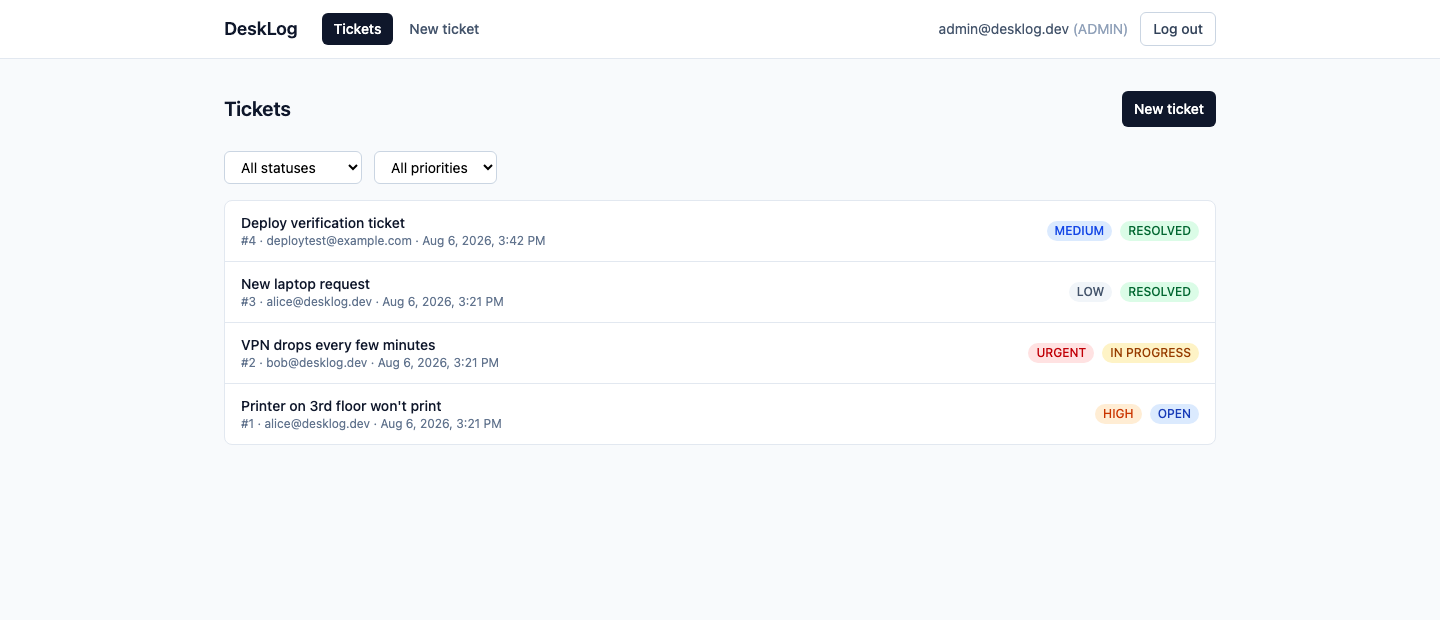
DeskLog exists because of a gap, not a feature idea: Java/Spring Boot is the second-most common backend stack showing up in the NZ roles I was scanning, and I hadn't touched it commercially. Rather than claim it on an application form on faith, I built a small, real ticketing app with it — JWT auth, ticket CRUD with filtering, a comment thread, and a live status-change workflow — end to end, deployed, in one sitting.
Two real bugs, caught by actually running it
The value of building something real instead of following a tutorial showed up almost
immediately. A duplicate-email registration and a validation error were both coming back as
bare 403 Forbidden instead of their real status codes — not because the logic was wrong,
but because Spring Security's anyRequest().authenticated() was silently blocking the
internal servlet forward to /error that those exceptions trigger. And missing or invalid
JWTs were returning 403 instead of 401, because Spring Security's default behaviour doesn't
distinguish "not authenticated" from "authenticated but forbidden" without an explicit
AuthenticationEntryPoint. Neither shows up by reading the code — only by registering a user
twice and watching the response.
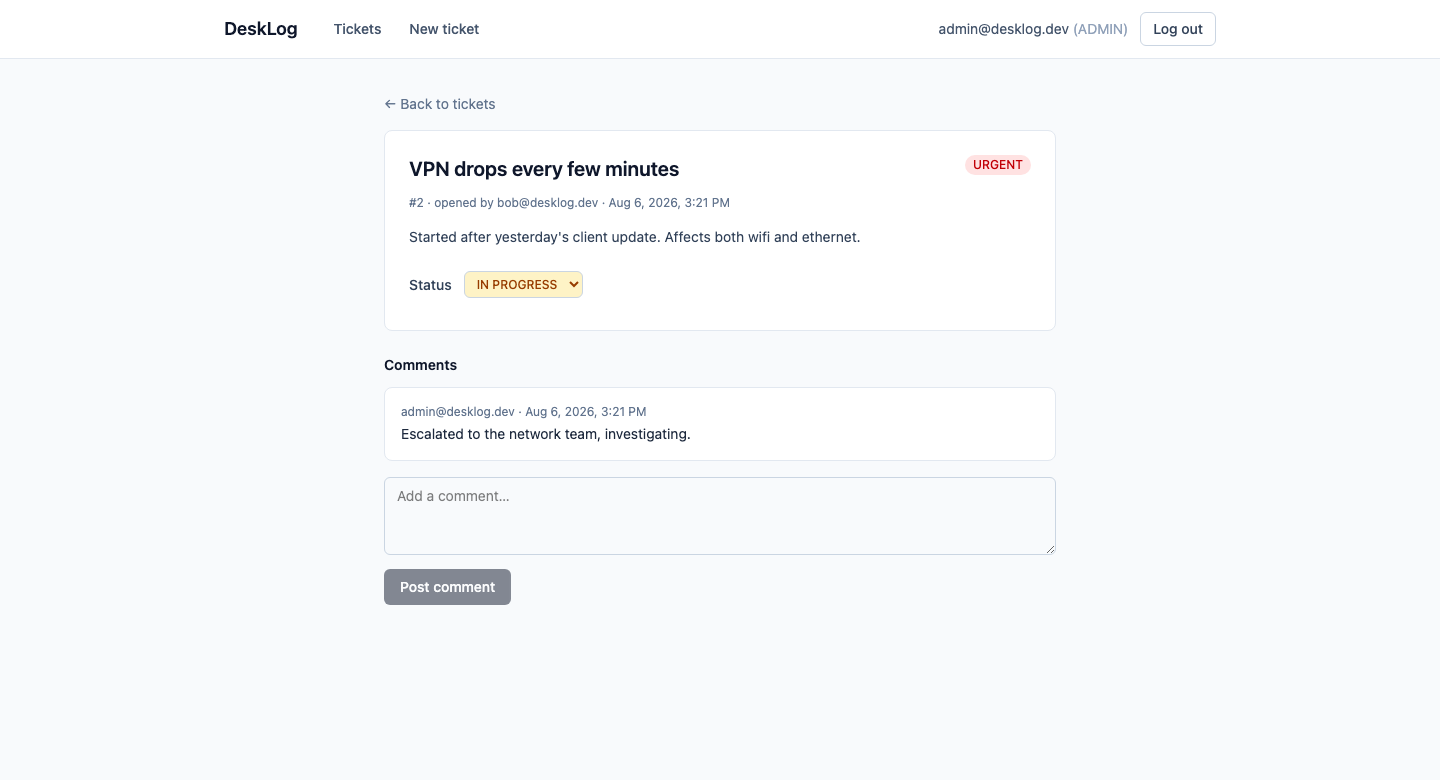
A ticket's detail view is where the actual workflow lives: a live status control and a comment thread underneath it, so a fix doesn't just get marked done silently — it gets a paper trail.
Building against a moving target
The plan called for Spring Boot 3. By the time I actually scaffolded it, start.spring.io
had aged out of generating 3.x projects at all — the ecosystem had moved to Boot 4 in the
interim. Rather than force an outdated version, I checked the generator's real compatibility
range, confirmed the move to 4.1.0, and adjusted — which meant verifying, not assuming, that
things like springdoc-openapi and the exact Spring Security 7 API still behaved the way the
older tutorials I'd have otherwise followed assumed.
Seed data that has to survive a restart
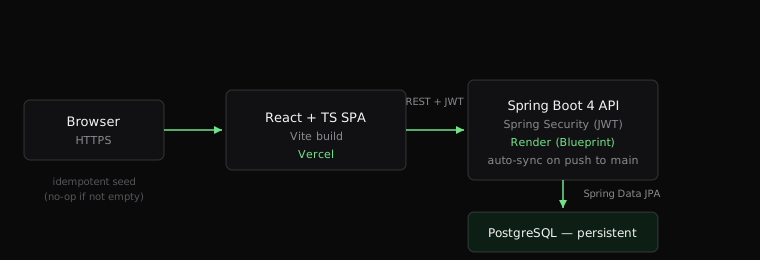
Local dev runs on H2, wiped clean every restart, so seeding it on every boot is free. The deployed version runs on a real, persistent Render Postgres instance — reseeding blindly on every restart there would just keep duplicating demo tickets forever. The seeder checks for existing data first and no-ops if the database isn't empty, a small but deliberate difference from how the same pattern worked in an earlier ephemeral-SQLite project.
What's actually built, and what isn't
Auth, ticket CRUD with filtering, comments, and status changes all work end to end against a
live Postgres database — not a demo mode. It's deployed at
desklog-web.vercel.app, with the API's Swagger UI left open
at /swagger-ui.html since there's no real user data at risk. What's not built: status
changes have no ownership check (any signed-in user can change any ticket), and there's no
self-service way to become an admin — deliberate scope decisions for a project sized to prove
the stack, not to be a complete product.